
Written by CCIA Safety Consultant Jeff Kearnan; originally posted on Kearnan Consulting Group.
Across the United States, First Amendment auditors have increasingly targeted houses of worship, synagogues, churches, mosques, gurdwaras, temples, and other faith centers by filming congregants, parking lots, and entrances. While auditors claim constitutional rights, houses of worship are private property and retain full authority to restrict or deny recording on their grounds. This article provides a structured, board-ready framework for faith leaders, staff, and volunteers to respond lawfully and calmly, with citations to federal and state law.
Our resident safety expert, Jeffrey Kearnan of Kearnan Consulting Group, has written detailed guidelines that incorporate best practices, legal considerations, and practical steps for faith communities when responding to First Amendment auditors.
Legal Standing of Houses of Worship
1. Private Property Rights
- Houses of worship, though open to the public for services, remain private property owners.
- Property rights allow leaders to regulate conduct, including recording, photography, and live-streaming.
- Courts have consistently held that the First Amendment does not apply on private property (Hudgens v. NLRB, 424 U.S. 507 (1976)).
2. Trespass Laws
- States empower property owners to restrict access and remove individuals who refuse to comply (see Appendix for the full list of states).
- California: Cal. Penal Code § 602 (trespass)
- Nevada: Nev. Rev. Stat. § 207.200 (trespass)
3. Federal Protections
- FACE Act (18 U.S.C. § 248): Protects all houses of worship from obstruction, intimidation, or interference.
- Public Forum Doctrine: Recording rights apply in public spaces (streets, sidewalks, parks), not on private grounds (Glik v. Cunniffe; ACLU v. Alvarez).
Comparative Incidents by Faith Group
| Faith Group | Incident Examples | Legal Response | Recommended Policy Actions |
|---|---|---|---|
| Jewish | Synagogue filming in Los Angeles (2019) led to armed security confrontation; auditors often record entrances and congregants, raising antisemitism concerns. | Private property rights allow restriction; trespass laws apply; FACE Act protects against obstruction of worship. | Post signage; train staff in de-escalation; document incidents; avoid armed escalation unless imminent threat. |
| Christian | California churches (2024) filmed in parking lots; Minnesota (2025) protesters disrupted worship, arrested under FACE Act. | Trespass enforcement under state law; FACE Act prohibits obstruction; police may intervene if disruption occurs. | Clear recording policy; calm trespass script; consistent enforcement; involve law enforcement when refusal continues. |
| Islamic | Mosques in Oklahoma & Michigan filmed by auditors; one case involved armed auditor outside mosque/church (2019). | Trespass laws apply; FACE Act covers mosques; police intervention justified when intimidation occurs. | Signage at entrances; security trained to issue trespass notices; avoid physical confrontation; call police promptly. |
| Sikh | Gurdwaras in California & Canada filmed during services; sometimes linked to political disputes (e.g., Khalistan activism). | Same private property protections; trespass statutes enforceable; FACE Act applies to Sikh houses of worship. |
Written recording policy; community liaison with law enforcement; consistent enforcement during festivals. |
| Hindu / Indian | Temples in New Jersey & Texas filmed during festivals; auditors livestreamed congregants entering/exiting. |
Trespass laws apply; FACE Act covers Hindu temples; police can enforce removal if refusal continues. | Post festival-specific signage; train volunteers in trespass script; document incidents; coordinate with local police. |
| Other Faiths | Smaller or minority groups (Buddhist temples, indigenous spiritual centers) have reported auditors filming ceremonies or parking lots. | Same private property protections; trespass statutes enforceable; FACE Act applies broadly to houses of worship. |
Adopt uniform recording policy; signage; volunteer training; incident documentation; law enforcement coordination. |
Communication Guidance for Staff & Volunteers
Recommended Script:
Initial Notice:
“Hello, welcome. This is private property. Recording or live-streaming is not permitted without authorization from church leadership. Please stop recording.”
Clarify Rules:
“You are welcome to remain here if you comply with our property rules. If you continue recording without permission, you will be asked to leave.”
Trespass Warning:
“You are now being given a trespass notice. If you do not stop recording and leave the property, law enforcement will be contacted.”
Law Enforcement:
- Call the police if refusal continues.
- Document the encounter (time, date, names, actions).
- Do not physically touch or attempt to remove the person.
Best Practices:
- Post “No Recording Without Authorization” signage at entrances and parking lots.
- Train staff/security in calm, professional communication.
- Apply rules consistently to avoid discrimination claims.
- Maintain incident logs for liability defense.
- Coordinate with local law enforcement for rapid response.
Avoid:
- Do not argue constitutional law with auditors.
- Do not physically engage or attempt to seize devices.
- Do not allow selective enforcement (e.g., permitting friends but denying others).
Practical Takeaway
- Parking lots, outdoor grounds, and curtilage are private property.
- Auditors’ First Amendment claims do not apply on church, mosque, synagogue, gurdwara, or temple property.
- Best practice: Calmly enforce rules, issue trespass warnings, and involve law enforcement if necessary. Parking lots and grounds are private property.
Pocket Card: Responding to First Amendment Auditors – Don’t Take the Bait!
Auditors want confrontation. Stay calm, professional, and consistent.
- Step 1: Initial Notice
- Step 2: Clarify Rules
- Step 3: Trespass Warning
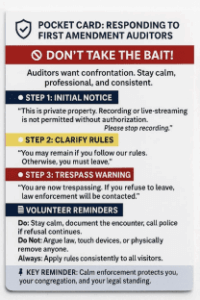
Volunteer Reminders
- Do: Stay calm, document the encounter, call police if refusal continues.
- Do Not: Argue constitutional law, touch devices, or physically remove anyone.
- Always: Apply rules consistently to all visitors.
Legal Anchor
- Houses of worship = private property.
- Trespass laws empower removal.
- FACE Act (18 U.S.C. § 248) protects against obstruction of worship.
Key Reminder: Calm enforcement protects you, your congregation, and your legal standing.
Sources:
- Hudgens v. NLRB, 424 U.S. 507 (1976) — First Amendment does not apply on private property.
- Glik v. Cunniffe, 655 F.3d 78 (1st Cir. 2011) — Right to record in public forums.
- ACLU v. Alvarez, 679 F.3d 583 (7th Cir. 2012) — Recording rights in public spaces.
- FACE Act (18 U.S.C. § 248) — Federal protection for houses of worship.
- California Penal Code § 602 — Trespass law.
- Texas Penal Code § 30.05 — Trespass law.
- Florida Stat. § 810.08 — Trespass law.
Have Additional Questions?
You’re always welcome to reach out directly to your CCIA Account Manager, or contact Jeff with safety-specific questions at: asksafety@ccia.com.
Jeffrey C. Kearnan
Kearnan Consulting Group, LLC
About Jeff Kearnan
Jeff Kearnan is a retired Assistant Sheriff, former director of Emergency Services, former Assistant Deputy Director of the Northern California Regional Intelligence Center, former USAF noncommissioned officer, holds degrees in Homeland Defense and Security Studies and Criminal Justice Management. Mr. Kearnan is a security consultant for Church and Casualty Insurance Agency and owns a successful consulting firm that specializes in expert witness testimony in civil lawsuits involving negligence, premises liability, standard of care, and police practices and use of force cases. Mr. Kearnan is called upon to perform threat and vulnerability security risk assessments for houses of worship, corporations, and government infrastructures. Mr. Kearnan uses his training, education, and experience to help houses of worship stay safe by preparing and planning for predictable surprises in way of policy, procedure, training and response plan writing.